I started my computing career feeding Fortran cards into a reader in high school. Drop the deck, and you got to renegotiate your relationship with sequential order. So when I say I've watched software define how humans work for fifty years, I'm not being rhetorical. I have the paper cuts.
Here's what all that software did: it defined work. Every application came with an interface, and every interface came with a department to serve. The ERP told finance what finance was. The CRM told sales what sales was. We didn't organize companies around what needed to happen — we organized them around what the screens could show. The org chart became a mirror of the app stack.
Now everyone wants to talk about the AI-driven company. Satya Nadella says business applications will collapse into agents. Maybe. But the interesting question isn't which robot gets the keyboard — it's what humans do when the apps stop telling them what their job is. I'd rather talk about the AI-inspired company, because the real shift isn't the automation. It's the permission to stop thinking in applications at all.
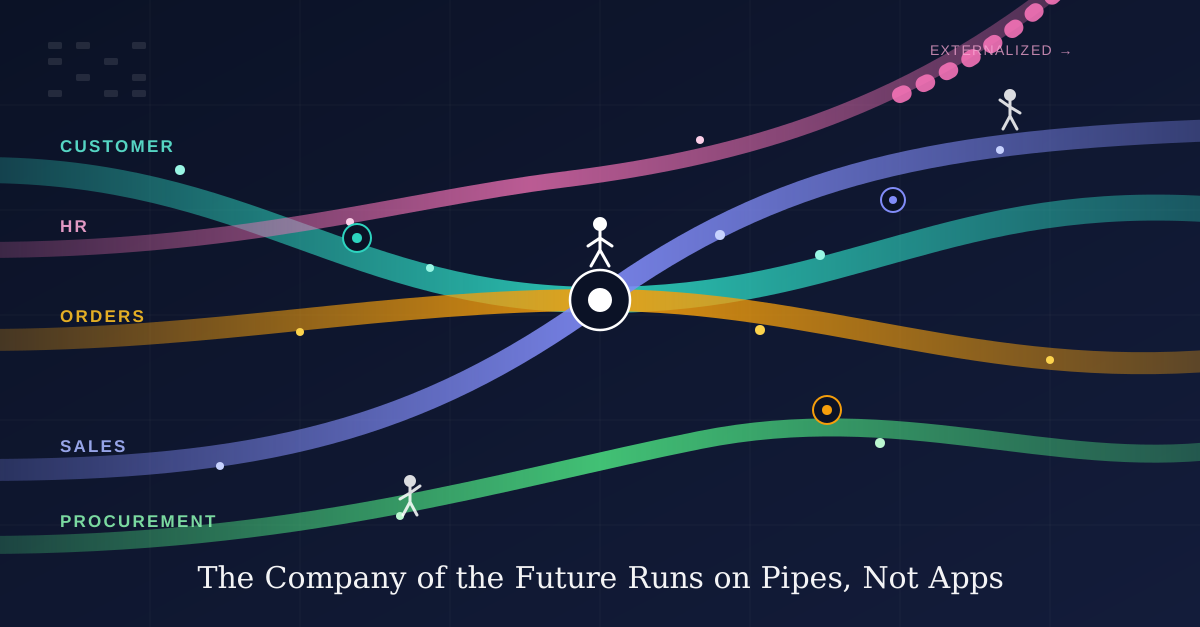
Imagine the company of the future as a set of data pipes. A customer pipe. An order pipe. Sales, HR, procurement — each a flow of data, not a suite of screens. The pipes intersect, and the intersections are where the business actually lives: where an order meets a customer meets a procurement constraint. Humans operate on the pipes — inspecting, deciding, redirecting — from wherever they happen to be. Not "in the system." On the flow.
And here's the part that would have gotten you fired in 1998: externalizing a pipe is no longer a catastrophe. It's a strategy. Hand your payroll pipe to a partner, keep your customer pipe close, and make that choice deliberately, per pipe, instead of signing a decade-long treaty with a monolith.
Why is this hard to imagine? Partly because we were schooled not to. The popular story says our education system was built to manufacture factory workers, for the benefit of the factory. Historians will tell you that's folklore — Prussia wasn't even industrialized when it invented compulsory schooling. But the folklore is barely an exaggeration. Ellwood Cubberley, one of the most influential education administrators in American history, wrote in 1916 that schools are "factories in which the raw products (children) are to be shaped and fashioned." Bells, batches, rote memory, deference to the front of the room. We optimized people for structured, authority-led environments — and then built enterprise software that looked exactly like the classroom. Rows. Fields. Permission to speak.
That training was fine for a world of knowns. We don't live there anymore. In the world of unknowns, one of the very few things we actually know is this: there is data, there is more of it every day, and it merges and travels through valleys nobody forecast. The winners won't be the ones with the best interfaces. They'll be the ones who deliberately chose their pipes — which data flows to own, which to externalize, which physical operations to keep, which to release.
The company of the future isn't a stack of applications with people attached. It's a set of chosen pipes with humans thinking on top of them.
I've been wrong before. Ask my card deck.